
Blog
Black vs Brown: Which Belt Do You Actually Need First?

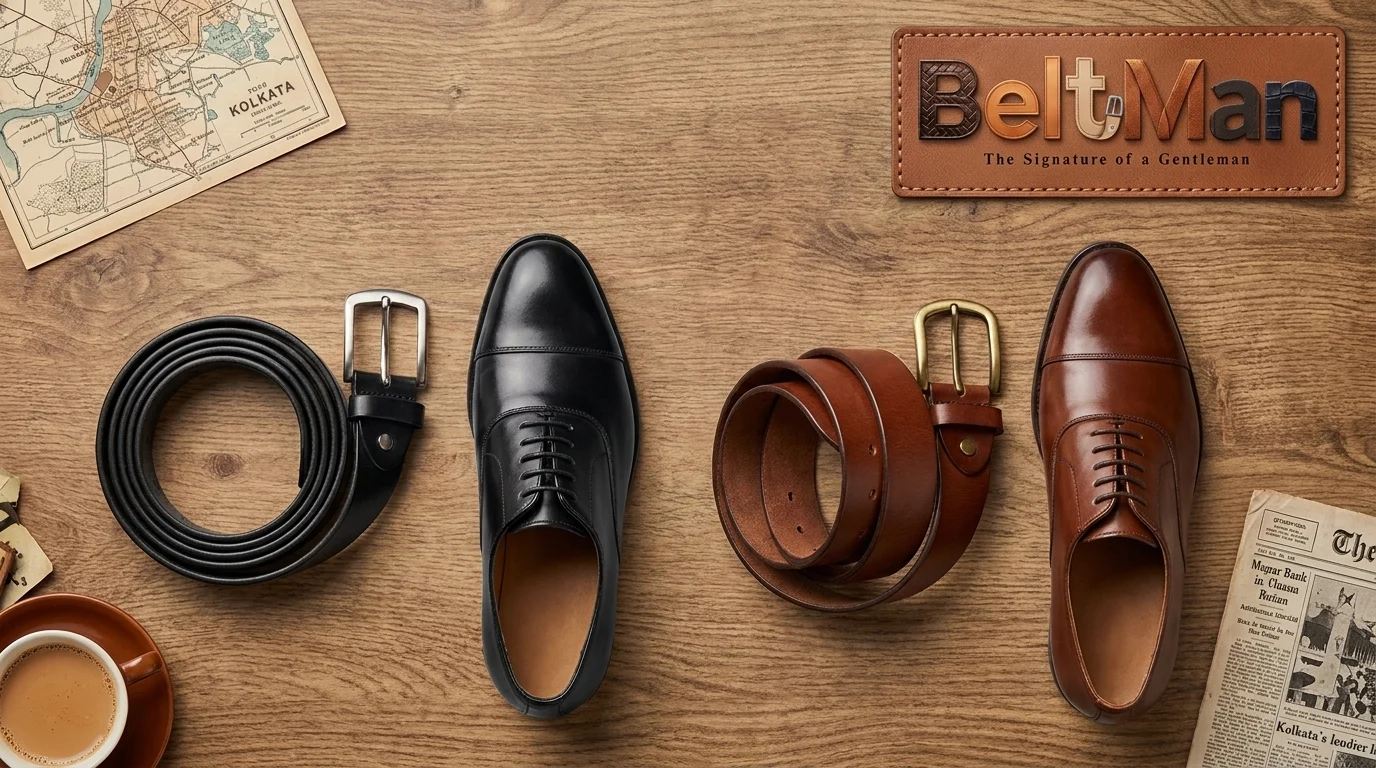
Every style guide has an opinion, and plenty of them contradict each other. Here's the honest answer, plus the actual rule that makes the color choice easy from here on out.
- The Quick Answer
- The One Rule That Actually Matters
- The Case for Black First
- The Case for Brown First
- So Which Do You Actually Buy First?
- Match Your Buckle Metal Too
- Black or Brown with Jeans Specifically
- What About Chinos and Formal Trousers?
- The Simplest Fix — A Reversible Belt
- Frequently Asked Questions
The Quick Answer
Check your shoe rack. Whichever color — black or brown — you own more pairs of dress or casual shoes in, buy that belt color first, because your belt is meant to match your shoes, not your mood on a given morning.
If your shoes are split roughly evenly, or you're building a wardrobe from scratch and don't have much to check against yet, buy black first. It's the one color with genuinely zero acceptable substitutes in formal settings — interviews, funerals, business formal, black-tie — while brown's real advantage is breadth across casual and smart-casual wear, situations where black still works fine, just not quite as warmly or naturally. Put simply: black covers the situations where nothing else will do; brown covers the situations where several things would technically do, just not quite as well as brown itself would.
The One Rule That Actually Matters
Match your belt to your shoes. Everything else in this guide is really just a footnote to that one sentence.
Black shoes get a black belt. Brown shoes get a brown belt. This is the rule menswear guides agree on more consistently than almost anything else in the category, and the reason behind it is simple: your eye naturally travels between the two visible pieces of leather in an outfit — belt and shoes — and when they align, the whole look reads as put-together rather than assembled without much thought. A black belt with brown shoes, or the reverse, is the single most common accessory mismatch out there, and conveniently, it's also the easiest one to fix, since it requires remembering exactly one rule rather than memorizing an entire outfit-matching chart for every occasion.
The Case for Black First
Black is the belt with no acceptable substitute in the situations that actually matter most whenever they come up.
Job interviews, funerals, weddings, business-formal offices, black-tie events — in every one of these, a black belt paired with black shoes is the only genuinely correct call, and no shade of brown, however dark or expensive, fully substitutes for it in that specific context. If your work or social calendar includes these situations with any regularity — and for most adults, at least one of them shows up sooner or later — black is the non-negotiable first purchase, because there's no way to improvise your way out of not owning one when the moment actually arrives.
The Case for Brown First
Brown is the belt that works in more of the outfits most people actually wear on an average, unremarkable day.
If your daily life leans casual to smart-casual — jeans, chinos, a rotation of brown or tan shoes rather than black dress shoes — brown, specifically a mid-to-dark shade like chocolate or espresso, pairs comfortably with a noticeably wider range of outfit colors and denim washes than black manages to. It also doesn't carry the same all-or-nothing formality that can make black feel slightly like overkill on an ordinary Saturday. It won't help you in a strictly formal setting, and there's no getting around that limitation, but for the majority of days that aren't strictly formal, it's genuinely the belt doing more of the actual, visible work in your wardrobe.
So Which Do You Actually Buy First?
The honest answer depends on what's already hanging in your closet, not on picking a side in an internet debate that's been running for years without resolution.
Count your shoes. If black dress shoes outnumber your brown or tan pairs, buy black first — you'll get immediate, regular use out of it, and it'll match what you already reach for most mornings. If brown, tan, or casual shoes dominate your collection instead, buy brown first for exactly the same reason: matching what you actually own beats matching a rule written for someone else's wardrobe. If you're building a wardrobe from nothing and genuinely can't answer that question yet, default to black: it's the belt you can't talk your way around in a formal moment, while brown's versatility advantage, real as it is, is a matter of degree rather than a hard requirement you'll be caught without. Either way, the second belt you buy should be the other color — not a third color, not a "safer" middle option — since between just the two of them, black and brown cover nearly everything you'll actually be asked to wear.
Match Your Buckle Metal Too
A belt can match your shoes perfectly and still look slightly off if the buckle metal is quietly fighting your other hardware.
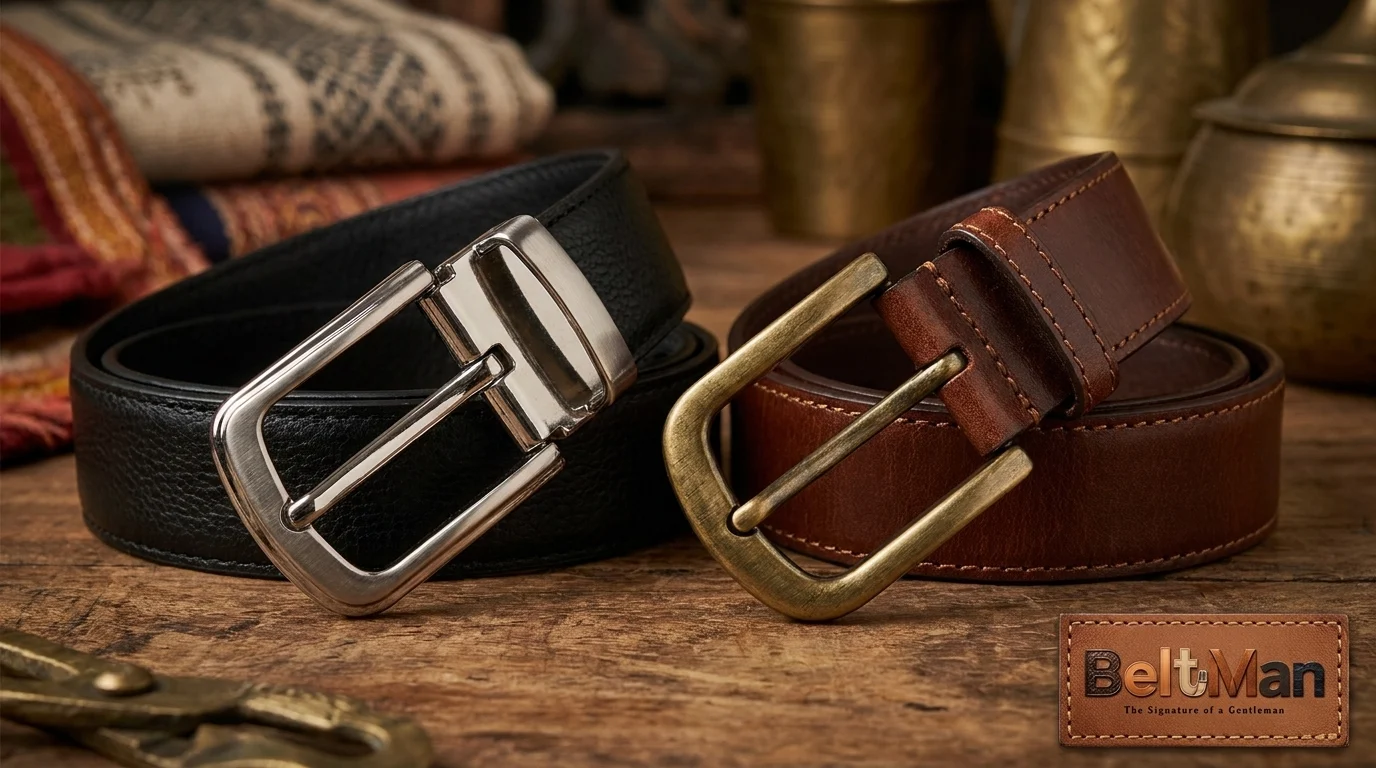
Silver, steel, and chrome buckles pair naturally with black belts and with any silver-toned watch or jewelry you happen to be wearing that day. Gold, brass, and antique-finish buckles pair naturally with brown belts and warmer-toned hardware generally. This isn't a strict law the way shoe-matching is — nobody's going to seriously fault you for getting it slightly wrong — but it's an easy, nearly effortless upgrade once you know to look for it: check your watch case and any other visible metal before you buy, and match the buckle to that, rather than picking whichever buckle simply looked nicest sitting on the shelf.
Black or Brown with Jeans Specifically
Jeans are the one context where the shoe-matching rule gets a genuine, worthwhile exception.
With blue denim, brown is generally the stronger pairing even when your shoes lean more neutral — blue jeans carry warm undertones from the indigo dye process, and brown leather sits comfortably in that same warm family, while black can occasionally read as a slightly cool, disconnected contrast against lighter washes in particular. With black jeans, black is the more reliable choice, creating one continuous dark line from waist to shoe that reads as deliberate rather than accidental — though a genuinely dark brown (espresso or chocolate, not light tan) can work well too, provided the shoes are brown to match it. Light tan or camel against black jeans tends to look like an accident rather than a considered contrast, so if you're going to break from black on black jeans, keep whatever brown you choose genuinely dark rather than light.
What About Chinos and Formal Trousers?
Jeans aren't the only casual gray area — chinos and formal trousers each lean one way, once you know what to look for.
True khaki-colored chinos sit naturally in the brown spectrum already, so a brown belt is the simple, low-effort choice rather than an active decision requiring much thought. Very dark chinos — navy, charcoal, black — behave more like black jeans in practice, and a black belt is the safer default there if brown isn't clearly working with the rest of the outfit's color palette. Formal trousers follow the same shoe-matching rule as everything else in this guide: if you're wearing black dress shoes with a suit, the belt is black, full stop, regardless of the trouser color itself, since the shoes are still the ones doing the actual deciding, exactly as they do everywhere else.
The Simplest Fix — A Reversible Belt
If the whole decision feels like more effort than a belt genuinely warrants, it's worth knowing there's a straightforward way around it entirely.
A reversible belt — black leather on one side, brown on the other, with a buckle that detaches or flips over — solves the black-or-brown question by simply not requiring you to choose at all. Beltman's reversible styles work exactly this way, giving you both colors in a single purchase rather than buying two entirely separate belts to cover the same practical ground. It's a genuinely sensible option for anyone who'd rather solve this once than keep thinking about it every morning. (→ Men's Leather Belts)
Frequently Asked Questions
Match it to whichever shoe color — black or brown — you already own more of. If you're starting from nothing, buy black first, since it's the color with no substitute in formal settings.
Brown generally pairs with a wider range of casual and smart-casual outfits and shoe tones. Black remains the only correct choice in genuinely formal settings, where brown simply doesn't substitute, no matter how dark the shade.
No — this is the one combination worth avoiding consistently. Match your belt color to your shoe color, not the reverse, and not to whatever color you happen to like more that day.
Brown, generally — it shares warm undertones with blue denim and tends to look more considered. Black works too if your shoes and the rest of the outfit lean black or distinctly cool-toned.
Black is the safest, most reliable choice. A genuinely dark brown (espresso or chocolate, not tan) can work as a deliberate warm contrast, provided your shoes are brown to match it.
Less than shoe-matching does, but it's a real, easily-fixed detail — silver or steel buckles suit black belts, gold or brass suit brown, matched to whatever metal you're already wearing that day.
Yes, for most people it's the practical middle ground — one properly fitted belt that covers both colors, rather than two separate purchases and two separate fits to get right.
Not urgently. Black and brown cover the overwhelming majority of situations most people actually encounter — a third color is a nice-to-have refinement, not a gap in the wardrobe.



Very helpful guide.
Now Im clear what color I need to choose according to my suit.